Sunday, August 26, 2012

Kamahouse


We spent the entire summer at our cabin one weekend. We went to Kuressaare twice, Pärnu three times, Tallinn eight times, Võru fifteen times, as well as stops in Põlva, Rakvere, Põltsamaa, Elva, Viljandi, Türi, Haapsalu and…Rapla. Rapla was an interesting place, surprisingly developed. What I mean is, Tartu is Estonia’s second city, so you'd think everything else in Estonia, Tallinn aside, is not going to be as nice in terms of infrastructure, right? Think again. But that’s not the point of this post.

The first time I was in Estonia I asked for something distinctively Estonian. I got kama served in kefir. Kama is a mix of different types of flour (barley, pea, and so on) that is mixed with various foods, mostly served today as a dessert. It kind of tastes like dirt, and if you like dirt, you’ll like kama. I never thought I would crave dirt for dessert, but I do. Dirt grows on you if you eat it enough.

So when Mrs. Mingus suggested lunch in a place called Kamahouse, in Tallinn at the corner of Kopli and Ristiku Streets, I didn’t expect much. “The burgers there are pretty good, I hear.” I imagined dirt mixed with pork and spicy ketchup for ten euros. It’s art.

But no, immediately upon entering it feels like a mix not of dirt and pork, but of Europa and Americana. The owner is an artist, as you can see by the use of red. The service was quick, friendly and polite, and each waitress wore a tag on her butt that read, “Hands Off!” Krista, our waitress, was kind enough to allow me to photograph hers. But only after she removed it and placed it on the table. I’m talking about the tag.

I have to say that the Kamahouse Burger was actually very good, especially at five euros. Served fast, with fries ordered separately. And this was the first place in Estonia (at least that I’ve seen) that offers a free refill on coffee. All too often restaurants are rigidly greedy and unbending in their thirst for money. One place in Tallinn charged me a whole euro for a glass of undrinkable, yellow tap water. I sent it back. “It smells like your toilet,” I complained. “You ordered it,” the waitress informed me. I still had to pay because she had already put it in the computer and couldn’t be bothered to delete it. The same place also charged me four euros for a Coke. These prices were not on the menu.

But not Kamahouse! Free refill on coffee, and other hidden goodies that Westerners take for granted in their own countries. Even the toilet offers you a choice, based on how badly you need to go. Coffee here (and remember, free refill!) costs one euro, according to the Bewerage Card. Lots of bewerages available here.

So as summer is over, I would like to compare some of my experiences from around the country.

Best burger: Sadhu in Kuressaare.

Worst burger: Pub Vaekoda in Kuressaare.

Most interesting justification for pricing: Ränduri Pubi in Võru. I eat and drink coffee here fairly often. Earlier this summer the coffee was substantially cheaper. Served in stone mugs, I just like it. I look forward to it. It’s still cheap, but it’s almost twice as expensive as it was a couple months ago. Here’s my conversation with Krista, the waitress, upon ordering:
“The coffee here used to be sixty eurocents.”
—No, no. It’s always been one euro.
“Always?” I asked.
—Yes, Krista replied.
“What was it two years ago?”
—Ten kroons.
“And how much is ten kroons in euros?”
—Um, about sixty eurocents.

Best sense of humor: the meat market in Tartu. I bought a carton of thirty organic eggs, got home, opened it up and found what is in this image. In English: “Please don’t eat us, we’re babies”.

Best overall dining experience: Meat Market Steak and Cocktail, in Tartu. The name says they just have one cocktail available, but that’s not true. A separate review of this place is coming soon, but I just have to say one thing about it here. We ordered a full meal. First was delicious bruschetta with bacon, and a board of food piled high. We were stuffed, and enjoyed our meal. But then Krista, our waitress, asked how we liked our steak. We hadn’t finished yet! The food was so good, and so much of it, that I wanted to “enjoy it in reverse”, if you know what I mean, just to feel human again in my stomach. Serious overeating involved in this restaurant. Soovitan! (The next image is from Meat Market, but the new Blogger software is very difficult to use.)

Worst overall dining experience: Citi Pubi, in Pärnu. At least, I believe that was the name. We sat down and decided to get one of the sandwiches from the menu. We had already ordered juice for the kids, so we couldn’t really leave. “Sorry, we’re out of sandwiches,” Krista the waitress informed us. I ordered soup instead. “Sorry, we’re out of soup.”
—What about this? I asked.
“Sorry.”
—This?
Krista frowned at me, saying nothing.
—What do you have then?
“We have sausages,” she eagerly replied. Despite the well-stocked nature of this place, the service was polite.
—Alright then, sausages for everyone!

Four plates of Estonian viinerid were served, three to a plate, surrounded by a mountain of fries literally dripping with potato seasoning, and a spoonful of shredded carrot. At that moment the large speaker behind my head came on, as it was time for the deejay to go to work. “Excuse me, could you turn that down? It’s right in my ear,” I kindly asked. I was told that it wouldn’t be fair to the other customers, who wanted to listen to Phil Collins.

Most interesting conversation with a taxi driver: Reval Takso, in Tallinn. I’ve been using this company for years. Cheaper than in Tartu, normally polite service, and fast. This time, however, was just funny. I stepped into the taxi early one morning, eager to get back to Tartu after a work meeting in Tallinn.
—Morning. Train station, please, I greeted Kristjan, the taxi driver.
“Seriously? I just came from there.”
—Sorry, but that’s where I need to go. (I already knew this was going to be fun.)
Kristjan sighed that heavy, Estonian sigh, then called it in over the radio. He said, “Get this: I just came from the train station with that foreigner. Now I’m going back. With another foreigner.”
—Um, you do realize I’ve been speaking to you in Estonian, right?
“Yeah,” Kristjan said. “But you don’t understand anyhow.”

Thursday, June 28, 2012

Sadhu


Everyone else seems to be going West these days, so we did, too. We took a week’s vacation in Kuressaare, in Saaremaa. That’s the main island off Estonia’s western coast. The last time I was there was also the first time I was ever in Estonia, so it was very good to revisit and re-evaluate some of my first impressions.

And my first impression of Estonia was—võileivad, or sandwiches. Except an Estonian sandwich is a half slice of bread with one of a million possible toppings, most of which contain fish, pâté, cheese or ham. To welcome me, the family I stayed with that first, fateful night laid out two full tables of sandwiches. I shied away from the fish and pâté, but that was also the first time I’d ever tried what I now consider my favorite Estonian food—garlic cheese on toast. 

Today, however, most traditional Estonian sandwiches have been replaced with various types of so-called “hamburgers”. Kiosks sell a large bun with a patty of mystery meat, shredded cabbage and carrot, and a ketchup and mayonnaise mixture that is dolloped on by the liter. But every once in a while…every once in a while…you get a delicious burger. But I’ll come to that in a moment.

The Mingus family arrived in the evening and we were hungry, and wanted to eat dinner in the sunshine. The only outdoor terrace (there are quite a few) that still had direct sunlight at that time was a place called Pub Vaekoda, on the main drag. I ordered the “Vaekoja Hamburger” with fries.

“What’s this burger like?” I asked Kristjan, the waiter.
—Um, it’s a patty in a bun.
“No, I mean what’s on it?” I specified.
—A patty? Kristjan seemed quite confused by my question.
“Is it a beef patty?”
—Yes.
“Pure beef, not anything else?”
—Yes.
“And what else? Tomato, onion, and so on?”
—Tomato, onion, and something else.

I could see I was getting nowhere, but this looked like a reputable establishment, so I took the plunge. For the kids, they wanted fish sticks. Kristjan said the plate was huge and that one portion would be enough for the Little Minguses. Mrs. Mingus ordered the burger as well.

A few short minutes later, the food was delivered. The kids’ plate was a mountain of over-salted fries, and three fish sticks. Not three each, but three total. Mrs. Mingus couldn’t eat more than three bites of her burger. The bun was rock-hard and the meat…I didn’t know what it was, but it was not beef. She left with the kids to go get something in the shop to eat in the hotel room.

When Kristjan returned, he asked how we liked it.
“Not very much, I’m afraid. You said this hamburger was pure beef. I know beef, and this is not beef.” He said he would go ask the chef, then returned a moment later.
—Yes, I’m sorry, it’s only fifty percent beef.
“What’s the other fifty percent?” I asked.
—The chef didn’t know.
“Where do you buy them from?”
—They’re made here in our kitchen, from locally raised and bought meat.

I didn’t want to know how they didn’t know what they were cooking in their own kitchen, so I just asked for the bill. Even though our dinner was only fifty percent food, Kristjan did give me a ten percent discount. Twenty euros for that.

The next evening, however, we ate at a placed called Sadhu. The “Sadhu Studio Mega Wild Boar Burger” intrigued me. It was the same price as that thing across the street from the night before. I was not expecting much. But I can say now that it is one of the top five hamburgers I have ever had in my life. I’ve never been a fan of wild boar, but this patty was simply succulent, so tender! Even the bun was delicious. The roasted potatoes were perfectly seasoned with fresh herbs, a wonderful mild, homemade salsa in place of ketchup, and a freshly fried egg (a lot of places will serve fried eggs that were actually fried hours—or days—before). I went back the next day and ordered it again. Still amazing.

The rest of the family was also more than satisfied with their dinners. But the kids were restless. They quickly tired of playing with the gigantic stuffed tiger from the sofa nearby. They can only play “Don’t Steal the Tiger’s Stripes” for so long, after all. I asked the very friendly waitress, Krista, if she had any entertainment for the kids. She brought back some paper placemats and a couple packs of crayons. Why she didn’t offer them immediately, I don’t know, but the Little Minguses were occupied for a whole hour, coloring in the pictures and playing the games on the printed placemats, and we ate and sat in peace. That’s a near-impossible feat when you eat out with the whole family.

I asked Krista where the restaurant had bought them, as it had an Estonian web address on it. Krista replied that they had just bought them an hour earlier, and the seller was still sitting in the other room. I went to go talk to her, because this was the first time I had ever seen anything like this in Estonia. Usually our kids were just bored in restaurants.

The seller, “Kristiina”, was more than willing to talk to me, and told me all about her experiences with dealing with loads of restaurants all over Estonia. I grinned with interest. “I have customers everywhere, but it’s hard to sell in Tartu. Tartu businesses just don’t want to make their customers happy, I guess.” That sounded very familiar. “We also offer customized placemats, too,” she continued. “A lot of hotels order those.”
On our way out the door, I asked Krista the waitress to give the chef my compliments. She smiled broadly and thanked me kindly. On the other occasions when I’ve done the same, in other restaurants of course, the waitress has actually frowned in confusion and simply replied, “Oh.”

The next day I took the Little Minguses to Kuressaare Castle, built in the fourteenth century. There’s a ton of educational stuff to see there, but if you go to the watchtower, I would advise against taking children. First you have to go through a dark, dingy corridor that shows what appears to be the dungeon. My older child asked, “Dad, what is this?”
—It’s the dungeon, I think.
“What’s that?”
—That’s where they put criminals.
“There are criminals here?” she asked in alarm.
—No, not anymore.
“I don’t like it here. I want to leave.”
At that moment, in the darkness and without warning, the sound of a lion roaring blasted from some unseen speaker. It was loud. My younger daughter started shrieking in panic, and the older one yelled at me, “Dad! Why did you bring us here?! You’re making my nerves get old too soon!”

We left without seeing the watchtower. But I began to wonder why they would have a lion roaring in the castle. Did they have a lion there? Was this one of the three lions that are on all the national insignia of Estonia? Did lions traditionally call the Estonian countryside home? Why not a lynx? Those exist here, and the President’s name is also “lynx” in Estonian (Ilves). Well, for better or for worse, I no longer have to read a nightly fairytale to my kids that takes place in a castle. Castles are too scary, now.

So a few brief bits about the rest of our vacation on the islands:
—Check out the Kaali meteorite craters, right off the main highway;
—Check out the Panga cliffs on the northern shore of Saaremaa;
—Check out the windmills in Angla;
—And whatever you do, do not attempt to eat on the ferry from the mainland to Muhu, as you literally will not have enough time to finish your food.

Overall a fun, fulfilling vacation. Soovitan!


Friday, May 4, 2012

An American Wedding

Recently I was lucky enough to be invited to an American wedding. After two flights of fourteen hours’ airtime, I found myself jet-lagged in Los Angeles, California. As if I needed to specify the state. But I spent a week there, and I can honestly say that I did not see a single stereotypically obese person. Not one. Most people were in fact in very good shape. Despite the fact that you have to drive for half an hour to get to a shop. I, however, went for daily walks, and a lot of people were staring at me as if I were from Europe.

This is an account of all my gastronomical experiences during that week.

First my friends and I went straight from the airport to a fast-food joint called In-n-Out Burger. Very good for the price, and if you know the secret password you can get all sorts of extra toppings (ask for your burger and fries “animal-style”). The cashier guffawed when I accidently asked for my fries doggie-style. Oops. Luckily I was saved by the Bible verse printed on the bottom of my cup of root beer.

Still on Estonian time, we began the bachelor party (which means we started the party at two in the morning my time). Picked up by a stretch-limo Hummer, this was the most ridiculous vehicle I have ever been in. But the three on-board bars helped pass the hour of driving time between stops. Basically, the whole party was taking a tour of local breweries. And there are many, many fantastic breweries.

First stop was the Noble Ale Works, in Anaheim. We sampled no fewer than eight pale ales and India pale ales. Average alcohol content about fifty percent more than an A.le Coq. Each of these recipes would no longer be available in a couple of months, as they are only brewed once. Constant innovation and experimentation. Each ale was a work of art.

Next stop the Playground, in Santa Ana. More amazing beers. All of it brewed on site. At this point I should mention that we were all wearing kilts. Not that it’s relevant, but nine guys wearing kilts consuming high-class beers was a bit different than nine guys in Tartu drinking Bock in Pirogovi Park dressed in denim.

I should also point out that these pints of joy cost about four euros each. That’s all. For another fifteen euros at a classy joint whose name I cannot remember (might be because of the Manhattans we consumed during the hour to the next stop), I ordered an amazing salmon dinner, in addition to the broad selection of appetizers. And yes, that salmon was delicious, but I am proud to say that Estonians can out-salmon Americans with their eyes closed. And soon after the salmon, my eyes were closed, too. My body just could not take the jet lag and booze. Luckily I had loads of room in the limo to stretch out and snooze.

The next day we ate a late lunch at some random restaurant in a marina in Long Beach. Very juicy beef patty, excellent Provolone and…ketchup. Yes, Americans eat ketchup, too. We just don’t use it for spaghetti sauce.

The day before the wedding was the rehearsal dinner. The Stone Brewing Company in Escondido, just north of San Diego. The food was succulent, and I don’t need to mention that the same applies to the beer, if you can use that adjective for beer. But the premises…the best layout I have ever seen. A gargantuan complex, large boulders everywhere (hence the name), and frogs. Once the sun set, conversation was difficult if you were outside due to the frogs. And they were real, as well. I was sure that because this was in the middle of a desert, and because it was America, it was just a sound effect. But I found no hidden speakers, and after my eyes adjusted to the low light in the park, I actually began to see the little amphibians jumping around.

The waitress, Christine, approached our table. What followed was a series of unanswered questions. “Hello, and how is everyone doing this evening?” Christine began.
—How are you? my friend asked.
“Would you like to order drinks?”
—A Stone Pale Ale, please, he said.
“Would you like to try our house special?”
—Where’s the toilet? I asked.
“Um, what?” Christine appeared visibly frightened, almost offended.
—Do you mean the “restroom”? my friend suggested.
“Okay, like, wow! The ‘restroom’ is…do you know where the downstairs bar is?”
—I can find it, thank you.

My friend reminded me that “toilet” was impolite in these United States. I responded with, “Oh, shit, you’re right!” The other people at the table looked at me like I lived in Europe. “So you live in Europe, right?” someone asked me. I said yes, that I lived in Estonia. They thought for a moment, then continued with, “So yeah, you live in Europe.”

On Saturday, we had the wedding itself. I believe that my favorite aspect of the ceremony and festivities—apart from the Southwestern décor, food, venue (the Bernardo Winery in Rancho Bernardo) and so on—was the company. The bride had three bridesmaids and a “bridesdude”. Two of the bridesmaids also brought their girlfriends. Homophobia, also known as “social immaturity”, just wasn’t an issue. Everyone enjoyed everyone’s company for one of the most joyful, memorable nights you could imagine.

As for the wedding food, it was a Southern theme. Pulled pork sandwiches with mustard sauce, baked macaroni and cheese, mashed potatoes with chicken gravy, plus “street tacos” with grilled mahi-mahi.

But the fun could not last forever. On the way out of San Diego the next day, we stopped at the crappiest looking Mexican dive we could find. Remember, in the States, crappier is better. For just six bucks I savored every bite of my beef burrito, cheese enchilada, refried beans and Mexican rice.

On the way to the airport we stopped for coffee and bagels. A simple onion bagel, that dense, savory big brother to the donut. Quite often the food in the States is very good. There is definitely variety. But I actually cooked that first night, and quite honestly had trouble finding fresh ingredients, like fresh mint, Parmesan that wasn’t processed and sold in powdered form in a green can.

I love visiting the States, but I’m happy here in Estonia. It’s good to come home. The day after my jet lag was over, I baked fresh onion bagels for breakfast and homemade beef and chicken enchiladas for dinner, followed by an A.le Coq something or other. As I fell asleep that night, the question of why there are no microbreweries in Estonia went unanswered.

Sunday, March 25, 2012

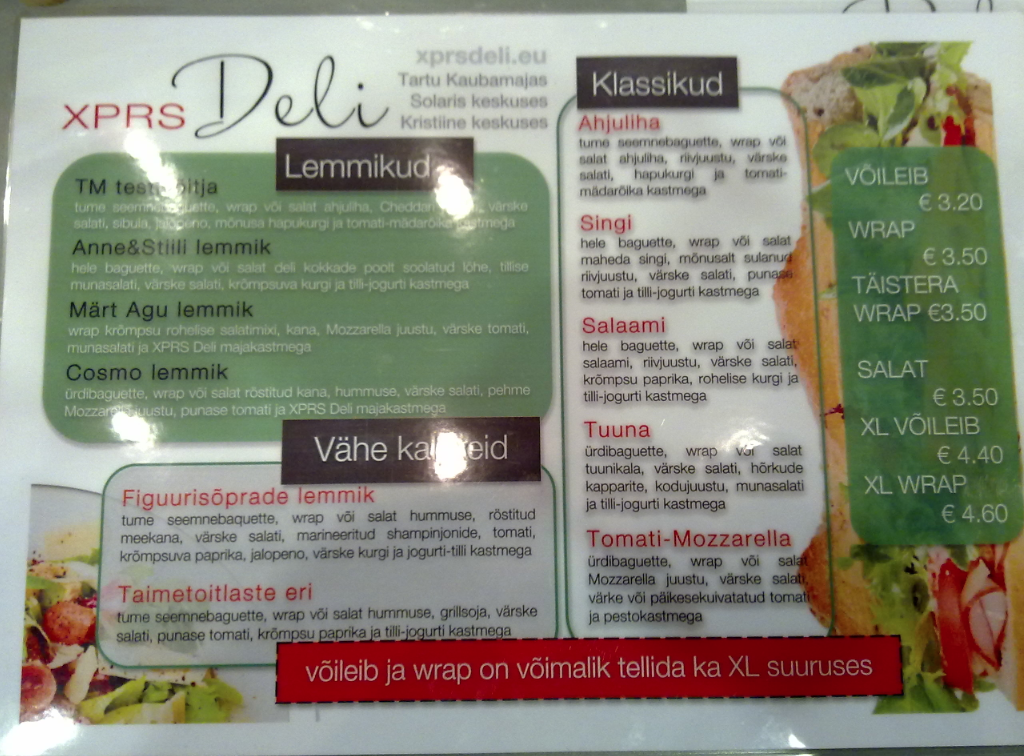
XPRS Deli

I am a man of many inconsistent prejudices. For example, I love peanuts, but I hate peanut butter. Well, alright, maybe “love” isn’t the right word. That’s just the American talking. You love your children, you like this peanut. But I do hate peanut butter. In the same way, I like cucumbers, and I like sauerkraut, but I despise pickles. All forms of them. I like beef, but I do not like porkbeef. What is porkbeef?

“Hey, there’s a new sandwicherie in Kaubamaja,” Mrs. Mingus informed me last week. Kaubamaja is Tartu’s downtown mall.
—I’m on it! I told her without even thinking. Within a minute, my coat was on and we were on our way downtown.
—So what’s it like?
“I just walked by it. I haven’t tried it yet,” she answered.
—What do they serve there?
“Sandwiches.”
—Right, but what kind?
“Stop it,” she told me. I was asking stupid questions. I wasn’t being very Estonian, and by that I mean I wasn’t thinking before opening my mouth. With today’s over-processed food, you really need to consider both what comes out of your mouth, and what goes in.
—So, it’s like Subway? I carefully asked.
“I think so. But I really hope it’s better than that cheap knock-off of Subway, called Metroo, across the river.” “Metroo” is the Estonian word for metro, or subway.
—Yeah, that place is nasty. Cheap, but nasty. You’re basically eating sandwich-flavored bread, they skimp so badly on the fillings.

We entered Kaupsi, as the locals call the mall, and went to the side entrance to XPRS Deli. An attractive little corner kiosk, I had high hopes. It’s an Estonian chain, but you won’t find the Tartu XPRS on your GPRS, or GPS or whatever the acronym is. It’s so new they haven’t even updated their webpage yet.

Not that it’s a problem for me, but the menus are only in Estonian. Even on the webpage, which says in Estonian, “The best chef is you—make your own sandwich!” That’s cool. But for most people in Estonia, a võileib, or sandwich (literally “butter bread”) is still an evolving food.

My first time in this lovely country, I was a guest in my friend’s aunt’s home. She had made an incredible butter bread smörgåsbord. At least ten different kinds of butter breads. But these weren’t what I considered a sandwich. Each consisted of a slice of bread with various toppings. Quite good, and a different experience. And having new experiences was why I had visited in the first place.

A sandwich for me was a massive baguette with three kinds of meat, and a lot of it too, a couple kinds of cheese, oil and vinegar, sliced onion, tomato, lettuce—Subway, basically. After years in Estonia, I can now honestly say that my favorite “sandwich” ever, however, is a slice of black bread with garlic cheese. Garlic cheese is grated cheese (no particular type) mixed with a little mayonnaise and crushed garlic. I cannot get enough of it. I do not love it, but I like it, yet I don’t like most Estonian cheeses by themselves, or the mayo. Don’t criticize me for that, though, because it’s not my fault. I can’t help what I like. All I can do is try new things.

“Hi, can I get the Men’s Favorite, please? But with no pickles,” I asked Õpilane, the waitress. That’s a pretty name.
—Of course, she smiled. What would you like instead of pickles?
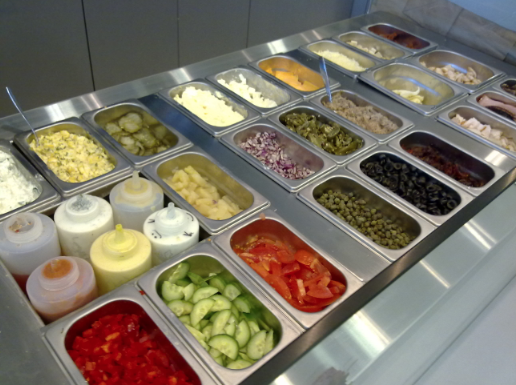
“Hmm,” I said, eyeing the wide selection of ingredients that were not protected by a sneeze guard. “What goes well with beef?”
—We don’t have beef, she informed me, a mildly odd look on her face in reaction to my apparently odd question.
“But,” I began. “But, the menu says this sandwich has röstbeef.”
—Ah, yes, that’s roast pork.
“Ah, I see,” I responded, intrigued at my discovery of a new element on the periodic table of deli meats: porkbeef. “What would you recommend?”
—I don’t know, Õpilane told me. I’m new here, my name is Krista, she continued.
“OK, could I have some jalapeños, then?” She looked confused for a moment. I found it odd that the sandwich station would be manned by a trainee, without supervision or instruction as to what she actually was selling, but I didn’t take issue with it. “Chili peppers, I mean.” And she happily placed some jalapeños on top of the porkbeef.

Mrs. Mingus ordered a sandwich for herself as well. The main ingredient was salmon. “We’re out of salmon,” Krista informed her, so she chose something else. Mrs. Mingus asked for Feta on her sandwich, and mentioned Feta three times. When she started to eat her sandwich, she noticed there was no Feta on it.

Krista mentioned that if you buy two sandwiches, you get one free. “Three equals two”, as the ad puts it. “You can build your own sandwich,” Krista said. “Just tell me what you want, and I’ll make it.” We decided to get soy meat. I don’t know what else to call it. Soybeef? We asked for any suggestions, but Krista didn’t know. She was very polite though, and eager to at least try and answer questions. She was about twenty. Had she been forty, she would have just answered our pestering questions with a cough.

The sandwiches themselves were, well, mediocre. At first I thought they were skimping on the fillings, but then I realized that you could order as many different kinds of fillings as you wanted. I just didn’t know what to order, and neither did Krista. But that’s not her job, I guess. Or is it? However, I did feel like they skimped on the meat.

The bread was good though. It was almost like a focaccia. XPRS Deli had a good selection, as well. But yesterday, Mrs. Mingus went back. The sandwiches were made by another person, who did not skimp with the fillings. The bread was dry, however, “crumbling apart”, she said.

One extremely minor thing that kind of bothered me was that the onions were diced, not sliced. The way vegetables are cut really does make a difference. Texture is all-important in cuisine. The tomatoes were tiny little chunks, too. Not the thick slices in the pictures on the menu.

I hope the owners read this, I can imagine one of them looking like Ned Stark. “Subway’s coming,” he mutters to himself. If XPRS Deli wants to survive, more attention needs to be paid to freshness, variety and consistency. In addition to porkbeef, maybe also serve realbeef. And garlic cheese! That would be awesome on a Subway-style sandwich. Also oil and vinegar.

I hope XPRS Deli doesn’t lose its head. Estonian integration to the West is both good and bad. Good for security, bad for local business. There is already McDonald’s in terms of culinary invaders. Local restaurants need to get their acts together. The Americans are coming, and they love processed food. Personally, I don’t love it. I don’t even like it.

Thursday, March 22, 2012

Hinkaali Maja

“What is Georgian food like?” my visiting friend asked after we'd ordered lunch at the Hinkaali Maja in Tallinn, across the street from the intercity bus station.
—Well, it's kind of hard to describe, I replied, not sure of how to answer. You know how in the US, Mexican food is easily the most popular, uh, minority cuisine? I ventured.
“Yeah,” he stared at me with mouth open.
—And in the UK, Indian food is the most popular minority cuisine?
“Yeah,” he once again replied.
—That's what Georgian food is here.
“But what's it like?” he pressed, fully aware I'd not answered his question.
—It has a lot of onion in it, I confidently stated.
He raised his eyebrows. “So, it tastes like onion?” he asked. He had been out of the US for only two days, his first trip abroad. Ever. I decided to have some fun.
—Are you familiar with Armenian cuisine?
He shook his head.
—Azerbaijani?
Nope.
—Iranian food? Pakistani? Saudi? Moroccan?
“I've had Moroccan before. It was good.”
—OK, it's nothing like any of that.

My visiting friend—let's call him “Mike”, because he's American—seemed to be undergoing the initial stages of culture shock. Symptoms of this included short-temperedness, an inability to understand why anyone would ever do anything differently than what he was used to, and an unwillingness to blend into the surroundings. Go native. Do like the Romans do in their own city.

“What did you order me?” Mike asked. The small, English menu only contained a portion of the larger, Estonian and Russian menu, so I had ordered what I thought he would like.
—I can't remember. I think it was chackapuli or something similar. The waitress took the menu.
“Well what's in it?” he continued.
—Want me to ask?
He nodded, so I went to go ask the extremely attractive waitress, Krista. Her name wasn't really Krista, but I don't know how to say Krista in Russian. I found her, and she smiled. “You have question?” she asked in basic Estonian.
—Yes, my friend would like to know what he ordered, and I can't remember, I slowly replied in Estonian.
“Your friend not want to order...” she tried to understand.
—It's OK, don't worry about it. I smiled reassuringly and returned to the table.
“So what did you get me?”
—No clue.
“Didn't you ask?”
—I did, but her Estonian wasn't strong enough.
“She doesn't speak Estonian?”
—No, not really, I replied.

I could hear the up-coming conversation, quoted with perfection in my own future vision. Mostly because I had had this conversation so many times before. He would ask why she didn't speak Estonian, if she lived in Estonia. I would explain recent history. He would then judgmentally state with authority that she lives in Estonia, she should learn Estonian. I would say that's a very black-and-white, or rather red-white-and-blue, way of looking at things. He would say something about Mexicans in America. I would fail in attempting to explain to him that that was a very different situation. And we would reach an impasse, neither able to convince the other, each feeling they were right and the other wrong. Although in my heart I knew I was more right than he was. And that was a very blue-black-and-white way of looking at things.

The chackapuli was delicious, according to Mike. He had never tasted anything like it. I explained how it likely had fresh basil, dill, parsley and cilantro as the primary seasonings. I had eaten a late breakfast, so I just got the—surprise, surprise—khinkali, or Georgian dumplings. The khinkali at the Hinkaali Maja were indeed as big as a house. Because that's what the name means. Dumpling House. Each plate had six of the gargantuan Caucasian ravioli—spiced pork and beef wrapped in a floury pasta-like thing that looked like a head of garlic. They were a bit difficult to eat, but they were even more difficult not to finish. What I mean by that is, well, I'm not sure. They were delicious, but there was a lot of food and I didn't want to finish them because I was full. But I didn't want to leave anything on the plate either, because it was so good. The end result? I economized on space in my stomach by not drinking my water, and I finished my plate, thirsty all afternoon as the end result.

This place was better than Tbilisi in Tartu, and a helluva’ lot cheaper too. Larger portions, better quality, and smaller prices. And I think Tbilisi is pretty good. This place is better.

“I find it odd,” Mike suddenly began, “that in a restaurant that serves the cuisine of a country that was recently attacked and invaded by Russia, in a restaurant that is located in a country that was also attacked and invaded by Russia, there is a beautiful woman who speaks no language but Russian.”

My jaw would have dropped at this American's surprising knowledge of history, except I was chewing on a khinkali. “You're not going to let this go, are you?”
—No, Mike said. I mean, I just want to understand. Why can't they just learn Estonian?
“A lot of them do,” I encouragingly answered.
—But she's young. Why didn't she already learn it? Estonia's been free for ten years, now!
“Twenty,” I corrected him.
—It doesn't matter. Her parents have had twenty years, or whatever, to learn the language. You live here, you learn the language. I mean, you did, and you're American. We're not exposed to language like other countries.
I was honestly pretty startled and surprised by Mike's reasoning. “Look. There's a long and complicated history at work here. Russia has more or less 'owned' Estonia at several points in the past. Most Russians here today arrived by order of their Soviet government. They arrived as conquerors, colonizers in a way. Russifiers. And then one day, poof! It's all gone. The Estonians get back their country. Understandably, there is some enmity from the Estonians toward the Russians. But things changed so fast. Most of the Russians—most, mind you—were completely alienated from Estonians. And still are today. Estonians and Russians alike both find themselves in unfamiliar territory. 'Learn my language!' one side shouted at the other, then all of a sudden, 'No, you learn mine!' I mean honestly, everyone wants the same things—peace, security, comfort, and so on—it's just a language. Who cares? They'll communicate in one way or another anyhow.” And I finished my speech.

Mike replied with, “But it's their language. You don't understand what it means to have people in your own country who make up a huge part of your country, but don't want to learn your language. Who refuse, in fact. That's a very American thing for you to say.”

I was confused as to how the tables had been completely turned on me. Was he talking about Mexicans? Or Russians?

But he went on. “Yes, the Russians should learn Estonian. It would be considered a good gesture, to put the past behind them. Another way of looking at it is take advantage of every opportunity you can in life. Learn everything. Including Estonian. And the Estonians on the other hand should be more patient and encouraging too, perhaps. To me, it sounds like because both peoples are in unfamiliar territory, these are your words, because they are both here, in this new situation, maybe they are both just suffering from culture shock. Symptoms of that include always thinking you're right, and not willing to accept new things. When in Rome. That sort of thing.”

I just didn’t reply any more at this point. From his simplified, outside, fresh-from-America point of view, the Russian–Estonian thing was so simple. And from my slightly inside point of view—I mean, I’ve been here for well more than a decade, and I know many, many half Russian–half Estonian families, families for whom this issue is strictly a non-issue—from my point of view, I just couldn’t see it as being more complicated than how Mike described it. Even though I knew it was.

Tuesday, January 17, 2012

III Draakon

“Welcome to the Third Dragon, where weary Travelers can fill their Tummies and partake of the Drink!” Krista the Wench greeted us in good English. We were three, and three were we. Two lady Jesters of international Renown and I.
—Hi, could we have a Menu? I asked.
“Menu?” Krista bellowed with Surprise. “Of what speakest Thou? We offer but one Food, and it is Soup of the Elk! One Ladle is one Money. All that we offer here is one Money!”
—Okay, and I paused to understand her. You only have one Food here, but you said everything we offer. What else do you have?
“We have Pastries. Pastry of the Elk, Pastry of the Beast, Pastry of the Carrot and Pastry of the Spinach,” she stated with Aplomb.
—Pastry of the Beast? I asked, Eyebrows raised.
“The Beast from whence you draw Milk!”

The two Jesters and I exchanged Glances. “It's good, I've been here before,” one of them said. “Everything is one Euro, and Drinks are two Euros.”
—Do you come from the Land of the Far East? Krista asked her, noticing her Asian Eyes.
“I'm from Sweden.”
—Ah, the Land of the good King Adolf. Welcome, thee! she exclaimed in what I was later told was perfect Swedish.
No Menus, I thought, and no Electricity. I don't carry Cash, either. Ever. Euromoney weighs too much in my Pocket. “Can I pay by Card?” I asked, just to be certain.
—Ah, thin Device of unknown Material. Yes, we can handle that.

We each ordered two Pastries and a Bowl of Soup, and sat down in the back Room. I immediately returned to the Register to ask for some Cutlery. “Thou art born with the silver Spoon, yet thou travelest with it not?” Krista asked in mock Rage.
—Can I just have a Spoon?
“One you may borrow.” And she gave me one of those Spoons with the wooden Handle, the ones made in Brazil, which Krista probably had not heard of yet. At least not while she was at Work. The other Jester also went to fetch a Spoon, and when she returned, said, “Wow, she speaks perfect Finnish as well!”

The Décor in the Third Dragon, written in Estonian as III Draakon, was beautiful. Probably very authentic. If you look at the Town Hall from the Square, in Tallinn, enter the Door on the Left. And with these Prices, it's likely the cheapest in Town. But our Pastries, Soup and Drink of the Cranberry quickly added up to six Moneys each. Not really expensive, but we were not exactly filled up either. I would want to eat again before dinner, and it was only two o'Clock.

But the Soup was good. It smelled amazing. Lentil Soup always does. The Elk Meat inside was delicious as well, although there was not much. The Pastries were tasty, but nothing better or worse than run-of-the-Mill Fazer Pastries available in every Shop in Estonia. I could not complain, however, due to the Atmosphere.

When suddenly the Atmosphere stank of Booze and Manstink. I felt a Tap on my Shoulder, and the two Lady Jesters gazed with Fright behind me. “Excuse me,” the drunken Voice began in English. “Do you need to use the Toilet?” I turned to see what appeared to be a Man with no Home, leaning right to my Face.
—No, I do not. It's right there, I replied, leaning back away from his Face.
“Thank you,” he continued. “Listen, can you help me? I need some Money to eat.”
—I don't carry Money, I informed him. He stood there. I'm sorry, but we're having a private Conversation, I continued.
I didn't want to tell a hungry Man to leave because we were having a private Lunch. But he just stood there, stinking, and exhaling what could have been Plague. One of the Jesters gave him a one-Money Coin.
“Thank you,” he smiled. Yes, he smiled, but he did not leave. Suddenly, Krista the Wench arrived to rescue us.
—Be gone thee! Be gone to thy Haystack, Man with no Haystack! I have told thee before, you may enjoy no Welcome here! she bellowed in Estonian.
“But I just want to eat,” he protested.
—Then thou must pay!
“I cannot afford your Food!” he practically shouted. Apparently he had forgotten the one-Money Coin my Swedish Jester had given him. Who was I kidding? He would spend that on more Drink. That's the Thing about Haystackless People. You never know if they will get drunk or get fed with Money you give them in Pity.

There is a homeless old Maid in Tartu who occasionally sits on the Steps near the defunct Kaubahall trading Market. She does not beg, Hand opened with Palm up. Every once in a While, I enter the Food Shop upstairs, and go to the Deli. I order a large Box of some Food they offer, have the Deli Worker heat it up in the Microwave, then I grab a Set of Cutlery of unknown Material, a Box of Juice and a Kohuke. I pay for it, and even buy a nice Bag, also of unknown Material. I then give the Bag and all its Contents to the homeless Maid, and give her a Smile as well. I feel good about that. I do not feel good about giving Money. I noticed in the Man's Bag that he was carrying a Loaf of Bread and other Items fit for a King. Well, maybe not a King, but he definitely ate well.

But I began to think. Is it my Responsibility? To help People like this, I mean. “I pay Taxes, and my tax Money funds Programs designed specifically to help the Homeless,” many a person (yes, small P intended) with no Heart will say in Justification of their Unwillingness to help. And, well, they have a very valid Point. On the other Hand, many Homeless find it embarrassing to accept public Aid of this Sort. “Beggars can't be Choosers,” the heartless Man will continue. I still like to give an occasional, nice Meal to a homeless Maid on the Steps. It makes me feel good. It's even selfish, if you think about it. Like mental Masturbation. Yes, I'm doing Good for Another, but is it for the Sake of Good, for the Sake of the Recipient of my Help, or because it makes me feel good?

I like the mental Masturbation Analogy. You can have Sex to make a Child, or you can have safe Sex with your Partner just for Fun. If the Latter, then it is essentially two-Person Masturbation. It is, well, just for Fun. Makes you feel good. And it's the same Thing about Charity. Child-making is to Sex what Teaching a Man to fish is to Giving a Man a fish. The worst possible sex Offender is One who gives a large Sum to a Charity and uses his Name to do it. It is like doing your Deed in Public. An Advertisement.

On the way out of the Third Dragon, Krista was speaking fluent French to some Customers. “We have no Cake! Careful thee, lest thee lose thy Head over Cake,” she warned, then turned to another Customer and answered a Question in rapid Russian. I had no Doubt she also spoke German and probably Something else. Very impressive, for a Woman wearing a dirty Smock in a Basement Restaurant.

What if Tartu had a Place like this? With this kind of Interior. It would have to be on Rüütli Street, where the nicest, single large Venue is a Fabric Shop. That has to go. It's a good Place, but it needs to be not there. Bars, Restaurants, a Hotel, Currency Exchange, a Church, Handicraft and—Cloth so you can make your own Curtains!

But if there were a one-Money Restaurant in Tartu, it would surely serve Fries with Potato Seasoning, mystery Meat Burgers, Russian Ravioli (Pelmeenid) and sour Cream. And Ketchup. Must not forget Ketchup. Except it would cost a lot more than one Money, and the Staff would not eject the Haystackless.

Tuesday, January 10, 2012

Dedi

“Let’s go to that Greek restaurant for lunch today,” Mrs. Mingus suggested this past Saturday.
—Greek restaurant? In Tartu? I asked. Odd how they just now had Greek food in the self-proclaimed “Athens on the Emajõgi River”.
“No, it’s not in Tartu, it’s in Luunja,” she corrected me. Luunja is a small village a short drive from Tartu. In a few years, it will be a suburb. It’s locally famous for cucumbers. Cucumbers that cost three times as much as imported Spanish cucumbers. But I tell first-time visitors to Tartu that Luunja is actually famous for nukes, not cukes. The huge, industrial greenhouse there emits a powerful glow in the nighttime sky that is very visible from Tartu. The nuclear weapons that would be used for an attack on Western Europe, my story goes, were stored in Luunja, but there was an accident, and now the residents of Tartu have to leave for six months every five years to avoid radiation sickness. “Let’s go to Tallinn tomorrow,” visitors then reply, “immediately when we wake up.”

We loaded up the kids and set off in the direction of the imaginary radiation cloud. Several wrong turns later, trying to follow the directions to the Greek restaurant, we finally found it. “Closed today”, the taped-up printout on the front door read. I told Mrs. Mingus that the owners were probably going to be gone for half a year.

So we drove back to Tartu. “Where do they have a playground?” I asked.
—The new Ränduri restaurant in Tasku (the mall) has a nice one, Mrs. Mingus replied.
We walked through the sporting goods store to enter the restaurant over the bus station, the third such restaurant of a chain that started in Võru. Very cozy, very attractive interior, nice playground. Order from the bar. No one at the bar. Five-minute wait, still no one. “Where else is there an inside playground?” I asked.
—Dedi.

Dedi Cafe (sic!) and Bistro is on the top floor of the other mall in downtown Tartu, Kaubamaja, which means Department Store, which is right across the street from Tasku, which means Pocket. I hadn’t been there for years. When the Little Minguses were still taking naps in their baby carriage, we would go to Dedi often for coffee. I remember ordering a crêpe once with some sort of Indian spice mix all over the ham-and-cheese filling. It tasted exactly like the Indian food available in almost every other Estonian restaurant. Palatable.

“Third time’s a charm,” I said as we sat down. Krista the waitress promptly brought us menus. They had a special page for holiday dishes. I ordered the spicy holiday beef wok. I like beef. The wife ordered a bowl of chicken pasta, and the kids shared a crêpe with ratatouille filling, a vegetarian dish. We ordered just a couple minutes later.

While we were waiting, we sent the kids to the play corner. They were back in an instant. “There is a violent man on the television,” Little Mingus explained. I looked and saw a man running with a bloody ax on the screen in the play corner.
—Just sit here with us, I told the kids.
“Now I’m going to have a nightmare,” she complained. “Like with Darth Vader.” I had a hard time not laughing.

Twenty minutes later, I turned to see if our food was going to arrive soon. The chef was not even at his station. “I don’t get it,” Mrs. Mingus said. “Usually the food is really fast here.” Above the chef’s station was a chalkboard that advertised “minus fifty percent”, and nothing else. I assumed it meant half the staff was on vacation for half a year.

I browsed the menu again, and noticed that soft drinks were twenty percent more expensive than beer. But beer was cheap here. The atmosphere in Dedi is nice, in fact. Nice view, up on the third floor. I should point out, however, that we were in the restaurant section, not the buffet section. The buffet, if it hasn’t changed, was super expensive by the time you actually went to pay, as you had to buy everything individually. It really added up quickly, and frankly was sort of bland.

Mrs. Mingus said, “I need to buy a new wallet, and I know they have a sale downstairs. I’ll be back in just a minute.” Five minutes later she was back with a new wallet. Then the food was served. To be perfectly honest, I found my spicy beef wok to be absolutely boring. It was mildly spicy, yes, and it was perfectly crunchy, but there just wasn’t any taste. No soul to this food. It was even topped with dill. I didn't know people still cooked like that in restaurants. Dill and beef. Mrs. Mingus had to give her pasta to the kids, as they didn’t like their ratatouille crêpe. “It tastes like a rat made it,” Little Mingus joked in reference to the movie.

The ratatouille filling was indeed disgusting. Noxious, I would even say. It was like eating vegetables in acid sauce. It hadn’t gone bad, I knew exactly what the problem was. Canned tomatoes. They are very sour. Must add sugar and then boil for a long time. Some herbs and spices—flavor, to put it bluntly—would not hurt, either. “I don’t get it,” Mrs. Mingus said. “Usually the food is really good here.”

So rather than eating, Mrs. Mingus began to transfer the contents of her old wallet to the new one, and noticed that the zipper was broken. The part that you pull with your fingers was missing. She assured me she had inspected it before buying it. This had happened in the last ten minutes, but she could not find the little piece anywhere. She went to take it back to the shop.

“Mmm, this pasta is so good,” Little Mingus said. “It tastes just like butter.” Mrs. Mingus returned, rolling her eyes. “They wouldn’t give me my money back or exchange it,” she informed me. I hesitatingly asked why. “They’re going to send it off for an expert evaluation. Maybe I’ll get a new wallet or refund in thirty days.” The Estonian Consumer Protection law is anything but that.
—But you just bought it. Clearly it’s defective, I insisted.
“They said there’s no proof of that, and that I might have broken it on the escalator.” It was at that moment that I decided not to send back the ratatouille crap. I mean crêpe. It would do no good.

Mrs. Mingus, who was a regular in this fine dining establishment, noticed that today, the chef was a man. “Usually it’s a woman,” she pointed out. “She knows how to cook.”

We got up to leave, and I walked to the bar to pay, waiting for the woman in front of me to finish. When she did, I stepped up, card and receipt in hand, and Krista the waitress just walked away to wipe off dirty tables and remove completely empty plates of food. For dinner that night I made vegetarian tacos with beef. Mmm…yummy.